
Reviewed · KNOSSOS PALACE TOURS
Knossos: Labyrinth of Knossos Skip-the-Line Walking Tour
Knossos is not just a pile of old stones. It is a vast Bronze Age palace with more than 1,500 connected rooms, clever water systems, painted walls, storage halls, shrines, workshops, and grand courts. This 1.5-hour guided walk gives you a clear route through the site and the stories needed to make sense of the ruins.
I like the skip-the-line entry, especially because your ticket is tied to a selected time slot. I also like the focus on practical Minoan achievements, from drainage and bathing areas to the throne room and theater. The main drawback is the brisk length: Knossos covers about 20,000 square meters, so you will see the essential areas rather than every corner.
I especially value the live guide here. The guide turns the Minotaur and Labyrinth story into a doorway to the real site, then points out how much of the palace depended on planning and engineering. Be ready for sun, uneven walking, and strict arrival rules. Missing your time slot can mean buying a new ticket.
In This Review
- Key points at a glance
- Why Knossos deserves your morning
- Meeting your guide at the right time
- Entering the palace through myth and history
- Seeing the throne room and royal spaces
- Ancient plumbing that still earns attention
- The oldest theater and the ceremonial courts
- Workshops, sanctuaries, and the working palace
- What the $104 price includes
- Walking conditions and who should book
- A guide who makes the ruins readable
- Booking flexibility and simple planning tips
- Should you book the Knossos walking tour?
- FAQ
- How long does the Knossos tour last?
- What does the $104 price include?
- Is hotel pickup included?
- Where do I meet the guide?
- What should I bring?
- Is the tour suitable for wheelchair users?
Key points at a glance
- A Bronze Age palace spread across 20,000 square meters: Expect a substantial archaeological site, not a single preserved building.
- The original throne of Minos: See what is described as Europe’s oldest throne in a room tied to the palace’s royal power.
- Ancient engineering on display: Drainage systems, cleansing rooms, toilets, bathing areas, and storage spaces show how carefully the complex was designed.
- The Minotaur story has a real setting: Your guide connects Minos, Ariadne, the Minotaur, and the Labyrinth with the palace ruins.
- Skip-the-line entry with a licensed guide: The €20 general admission ticket, guided walk, and ticket-line service are included.
- A short but active visit: Wear good shoes, carry water, and arrive 20 minutes early at the main entrance.
Why Knossos deserves your morning
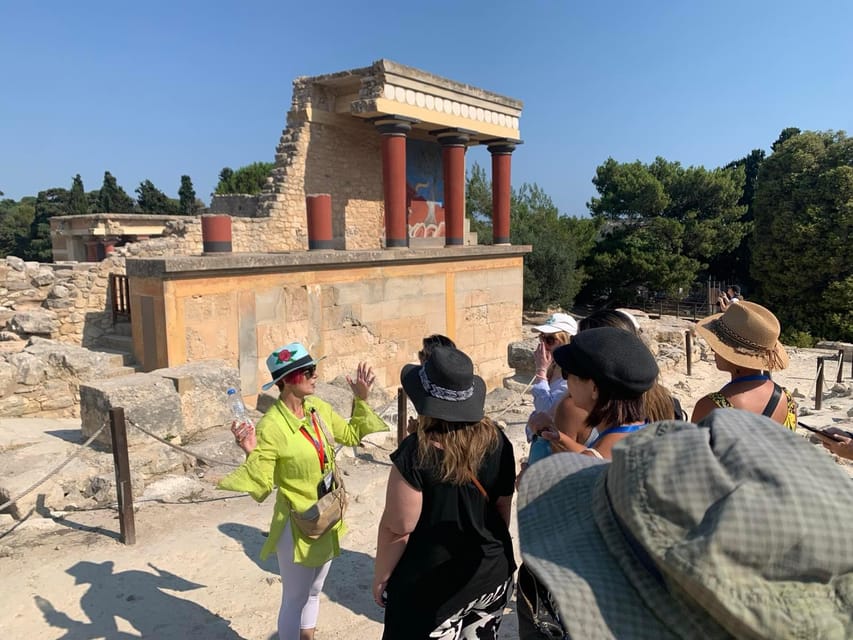
Knossos was the center of Minoan Crete during the Bronze Age. The first palace was built soon after 2000 BC, then destroyed by a major earthquake around 1700 BC. A larger palace followed and remained the leading center of power in Crete for more than 300 years.
That timeline matters because Knossos feels less like a single monument and more like a working city. The complex included religious spaces, royal rooms, workshops, pantries, ceremonial courts, and systems for managing water and waste. You get a glimpse of a society that could organize a huge building project long before modern machinery.
The tour uses the famous myths as an entry point. King Minos, Princess Ariadne, the Minotaur, and the Labyrinth are not simply decorative stories added to the visit. They help explain why this confusing network of rooms became one of the ancient world’s most powerful places in the popular imagination.
Your guide also helps separate legend from archaeology. That is important at Knossos, where the site’s real remains and later myths are closely linked. Instead of wandering from wall to wall and guessing what you are seeing, you get a running explanation of how the palace worked.
More Entry Tickets in Heraklion
- Heraklion Area: CRETAquarium Admission Ticket
★ 4.4 · 2,055 reviews - Crete: Palace of Knossos E-Ticket and Audio Guide
★ 3.8 · 1,540 reviews - CRETAquarium Entrance Ticket in Crete
★ 4.0 · 359 reviews
Meeting your guide at the right time
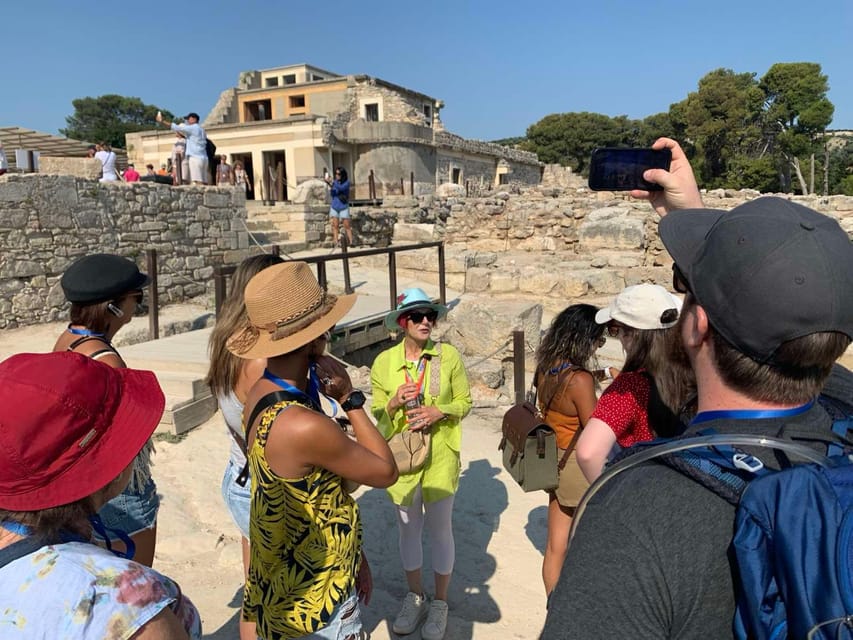
You meet at the main entrance to Knossos, in front of the ticket office, next to the archaeological site entrance. Look for the guide holding a sign with the Meeting Point, WeGuide logo.
Plan to arrive 20 minutes before the starting time. This is not casual advice. The tour uses a selected entry slot, and the start time is followed strictly. Arriving late can result in denied entry and the need to purchase another ticket.
That rule may feel fussy, but it protects the group’s schedule and the ticket arrangement. Knossos can be hot and exposed, so arriving early also gives you a moment to find the entrance, use the facilities if needed, and get ready for the walk.
The experience is shared with other people, not a private tour. It is described as a small-group walk, with headsets supplied if the group contains 7 to 16 participants. That setup is useful at an open archaeological site, where wind, distance, and nearby activity can make a guide hard to hear.
Entering the palace through myth and history
The opening part of the walk introduces the Palace of Knossos and its role in Minoan civilization. You begin to see the scale of the place quickly. The complex had more than 1,500 interlocking rooms, arranged over four storeys in its most developed form.
You will not walk through every room in 90 minutes. That would be impossible and exhausting. Instead, the guide leads you through key areas that show how the palace served royal, religious, economic, and practical purposes.
The story of King Minos and the Labyrinth works well here because the ruins are genuinely complex. Passages, courtyards, stairways, chambers, and storage areas create a sense of movement through a large administrative center. The myth gives the site drama, while the architecture provides the substance.
I like this balance. You get the memorable story, but you also learn that the palace was more than a legendary maze. It was a place where people stored goods, held ceremonies, practiced religion, worked in specialized workshops, and managed daily life.
Seeing the throne room and royal spaces
One of the strongest stops is the throne room, home to what is described as Europe’s oldest throne. The original throne of Minos gives the visit a direct link to the palace’s ruling authority.
The room is important even if you are not an archaeology specialist. It helps you picture Knossos as a seat of government and ceremony rather than only a collection of foundations. The guide explains the room’s place within the palace and the wider Minoan world.
The route also includes luxurious domestic quarters connected with the royal family. These spaces help show the contrast between formal public areas and private life. You might find it easier to understand the palace once you see how rooms were arranged for different purposes rather than treating the whole site as one mysterious structure.
The palace also had shrines, temples, and other areas tied to cult practice. Your guide explains how religion fitted into the daily and political life of Knossos. The exact condition of the remains varies across the site, so the spoken explanation is especially useful where only partial walls or foundations survive.
More Knossos and Minoan palace days:
- Knossos-Zeus Cave -Old Traditional Villages-Olive Oil Factory
★ 5.0 · 694 reviews - Crete: Knossos, Lasithi, Lasinthos and Olive Farm Combo Tour
★ 4.5 · 351 reviews - From Heraklion: Historical Center City Tour & Knossos Palace
★ 4.4 · 340 reviews - Knossos & Lasithi Plateau: Zeus Cave,Villages, Olive Oil Tour
★ 5.0 · 328 reviews
Ancient plumbing that still earns attention
The most surprising part of Knossos may be its practical engineering. The tour points out drainage systems described as among the oldest in the world, along with cleansing rooms, bathing areas, toilets, and other water-management features.
These details can be more revealing than grand rooms. A throne tells you about power. A drainage channel tells you how people actually made a large palace function.
The Minoans needed to move water, remove waste, and keep a complex building usable. Their systems show planning and technical skill that may be easy to overlook when you are focused on myth and palace grandeur. I like that the tour gives these less glamorous features proper attention.
You should also expect the guide to explain storage areas and pantries. Knossos had extensive spaces for holding Crete’s goods, which points to its role as an economic and administrative center. The palace was not simply a royal residence. It was also a place where supplies were collected, organized, and controlled.
The oldest theater and the ceremonial courts
Another major stop is the theater, described as Europe’s oldest theater. It offers a window into public gatherings and ceremony at Knossos.
The palace included spacious courts where people could gather for rituals, feasts, and other major events. These open areas give the site a different feel from the enclosed rooms and narrow routes. They also help explain how the palace could serve a large community rather than only a small royal household.
The theater and courts are valuable because they show public life. You are not only looking at where a ruler sat or where goods were stored. You are also seeing spaces built for shared events, display, and ceremony.
The route may move quickly through these areas because the entire tour is limited to 90 minutes. If you want time to linger at every wall, study every detail, or take long photographs, you may find the pace restrictive. If you prefer a structured introduction before exploring on your own, the shorter format works better.
Workshops, sanctuaries, and the working palace
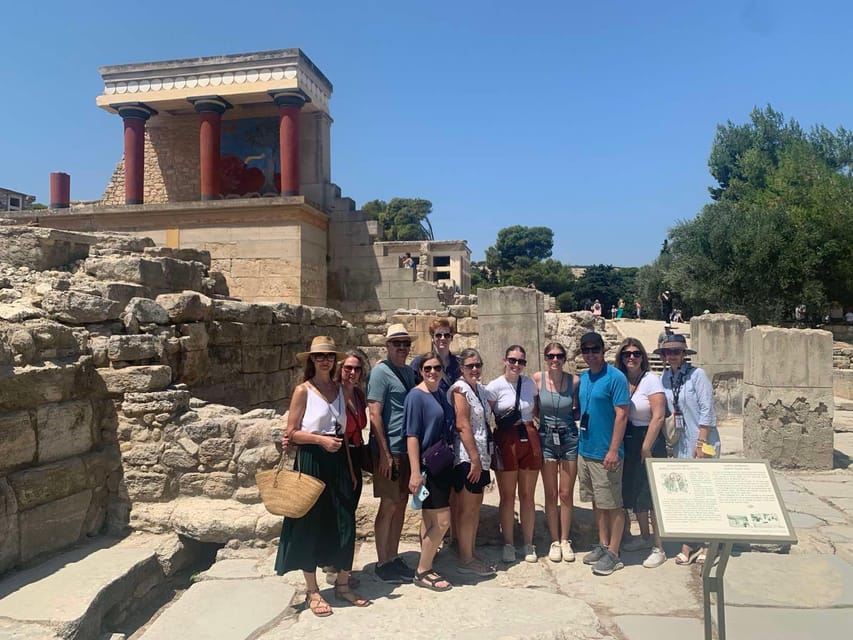
Knossos had specialized workshops, shrines, storage rooms, cleansing areas, and domestic quarters. Together, these spaces reveal a building that supported many kinds of work.
I find this part useful because it moves the visit away from the simple idea of a palace as a luxurious home. Knossos was a busy center of production, administration, faith, and storage. The guide helps you connect these functions so the site feels organized rather than random.
The Minoans are often remembered for colorful art and myth, but their engineering and planning deserve equal attention. The palace’s layout, water systems, multi-storey design, and large storage capacity show a high level of skill for the Bronze Age.
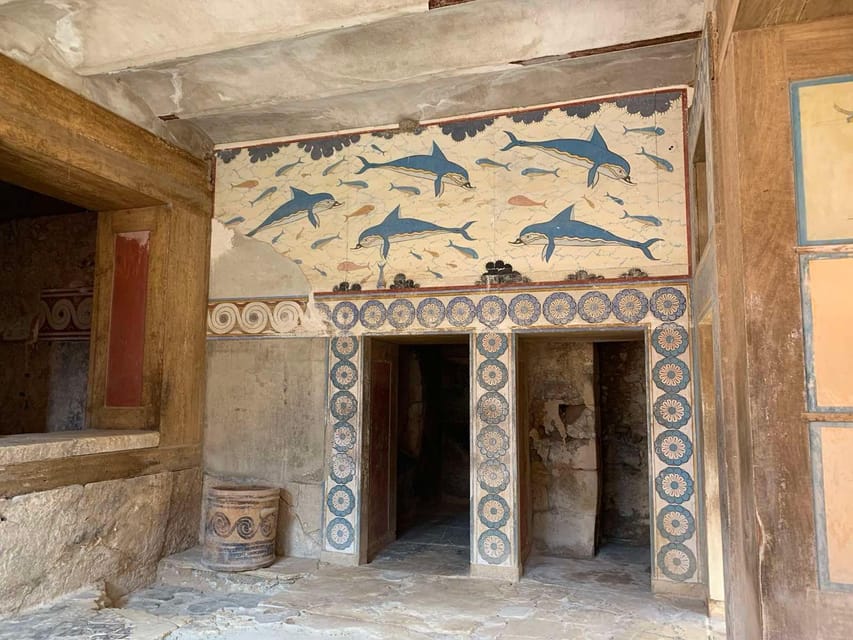
The tour also emphasizes the splendid frescoes that once decorated the walls. The condition and presentation of individual features can vary, but the guide gives you the context needed to understand how decoration supported the palace’s ceremonial and royal character.
What the $104 price includes
The price is $104 per person. That is not a cheap archaeological-site visit, but it includes several services beyond admission.
You receive the €20 general admission ticket to Knossos, skip-the-ticket-line service, and a licensed English-speaking guide for the small-group walk. VAT and related taxes are also included. If the group has 7 to 16 people, headsets are provided so you can follow the explanation more easily.
The main value comes from the guide and the time saved at the ticket counter. A self-guided visit costs less, but you would need to build your own understanding of the palace’s myths, layout, engineering, and historical periods. At a site this large, a good route and clear explanation can make the difference between a memorable visit and a confusing one.
The transfer option is separate. If you select it, transport is available from and back to the Heraklion city-center area for an added cost. Without that add-on, you make your own way to Knossos and meet at the entrance.
Food and drinks are not included, and food and drinks are not permitted inside the palace. Eat beforehand and carry water for before or after the site, especially on a hot day.
Walking conditions and who should book
Knossos requires a significant amount of walking. Comfortable shoes are essential, and you should bring water, sunscreen, and a sun hat. Smoking is not allowed on the premises.
This is not a good choice for people with mobility impairments, wheelchair users, or pregnant women, according to the stated suitability information. The 1.5-hour duration may sound short, but the site is large and the walking is continuous.
I would choose this tour if you want a guided first look at Knossos and care more about understanding the site than spending a whole day on every detail. It suits first-time visitors, history fans, and anyone who wants the Minotaur story explained alongside the actual palace.
I would think twice if you prefer complete freedom, a very slow photographic visit, or a self-guided audio experience. The group follows a fixed time and route, and the strict entry policy leaves little room for delay.
A guide who makes the ruins readable
The strongest praise in the available feedback is directed at the guide. One verified booking described the guide as excellent, informative, and helpful, while another called the experience simply very nice. The overall rating is 4.9 from 6 reviews.
That is a small number of ratings, so I would not treat it as a guarantee of every guide or every departure. Still, the comments point to the feature that matters most here: the quality of the explanation.
Knossos needs interpretation. The palace was damaged, rebuilt, altered, and excavated over time, and the myths can easily overshadow the evidence. A strong guide gives you a sensible path through the rooms and explains why each major area matters.
The English-only format also keeps the tour focused. If you need another language, this particular departure is not the right fit.
Booking flexibility and simple planning tips
You can cancel up to 24 hours before the activity for a full refund, and the reserve-now, pay-later option lets you hold a place without paying immediately. These terms are useful when you are still arranging your Crete schedule.
The most important planning step is choosing a time you can reach easily. Since the ticket is valid only for the selected slot, do not plan a tight connection with another activity. The meeting point is at the site, and the optional Heraklion transfer costs extra.
Before leaving your hotel, check that you have:
- Comfortable walking shoes
- Water for the walk
- A sun hat
- Sunscreen
- Enough time to arrive 20 minutes early
The palace itself does not allow food or drinks inside, so plan your meal around the visit rather than expecting a snack break during the tour.
Should you book the Knossos walking tour?
Book it if you want Knossos explained by a licensed guide, prefer to avoid the ticket queue, and value a focused route through the throne room, theater, royal quarters, storage spaces, and ancient water systems. The price is reasonable for a guided experience that includes admission and skip-the-line service, though the optional transfer raises the total cost.
Skip it if you need wheelchair access, have mobility limits, or want to wander without a fixed schedule. Also reconsider if you want several hours for photography and close study.
For most first visits, I would choose the guided option. Knossos is large, layered, and full of stories. Ninety minutes will not cover everything, but it gives you the framework to understand what you are seeing, from the legendary Labyrinth to the very real drains, workshops, courts, and storage rooms that made this Bronze Age center work.
FAQ
How long does the Knossos tour last?
The guided walking tour lasts 1.5 hours.
What does the $104 price include?
The price includes the €20 Knossos Palace general admission ticket, skip-the-ticket-line service, a licensed English-speaking guide, VAT and related taxes, and headsets when the group has 7 to 16 participants.
Is hotel pickup included?
Hotel pickup is not included in the standard tour price. A transfer from and back to the Heraklion city-center area is available as an added option at extra cost.
Where do I meet the guide?
Meet at the main entrance of the Knossos archaeological site, in front of the ticket office, next to the entrance. The guide holds a Meeting Point, WeGuide logo sign.
What should I bring?
Bring comfortable shoes, water, a sun hat, and sunscreen. Food and drinks are not permitted inside the Knossos Palace.
Is the tour suitable for wheelchair users?
No. The experience is not suitable for wheelchair users, people with mobility impairments, or pregnant women.
More Walking Tours in Heraklion
- Full Day Samaria Gorge 10-Mile Walking Tour
★ 4.5 · 52 reviews - Archaeological Museum of Heraklion: Guided Walking Tour
★ 4.9 · 26 reviews - Heraklion Through Local Eyes – A Walking Experience
★ 5.0 · 10 reviews - Heraklion: History & Culture Walking Tour with Food Tasting
★ 4.9 · 8 reviews
Just added around Heraklion
- Crete: Knossos Palace & Heraklion City Tour★ 3.5 · 3 reviews
- Full-Day Tour:Lasithi Plateau -Mythology Park&Knossos Palace★ 3.0 · 3 reviews
- Knossos: Knossos Private Guided Tour★ 5.0 · 3 reviews
- Snorkeling Tour with Sea Scooter in Heraklion★ 5.0 · 3 reviews
- Heraklion: Holistic Massage: Revitalization of Body & Spirit★ 5.0 · 3 reviews
- Gramvousa and Balos Tour From Heraklion★ 4.0 · 3 reviews
- Heraklion: Walking city tour & Wine tasting★ 5.0 · 3 reviews
- Private Wine Tour at Peza Valley – 2 Wineries and Lunch at Peza★ 5.0 · 3 reviews
Knossos Palace Tours, compared.
Knossos Palace Entry Ticket with Optional Audio Guide
Read our review →
Knossos Palace Skip-the-Line Guided Walking Tour
Read our review →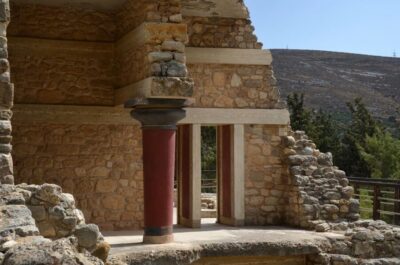
Knossos Palace and Museum E-Tickets with Audio Guides
Read our review →
Zeus Cave -Old Traditional Villages-Olive Oil Factory
Read our review →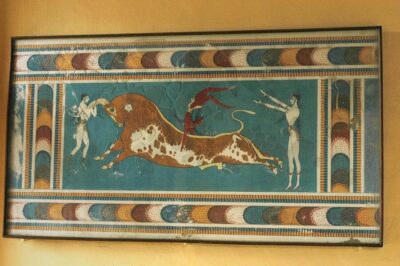
Knossos Palace Skip-the-Line Ticket & Private Guided Tour
Read our review →
Knossos, Lasithi, Lasinthos and Olive Farm Combo Tour
Read our review →Browse the lists this tour appears in