
Reviewed · HISTORICAL TOURS
Cretan Stories – A Journey Through History and Tradition
The most moving part of this day is Arkadi Monastery, where Crete’s struggle against Ottoman rule becomes personal and easy to grasp. You also visit ancient Eleftherna, a pottery village, Melidoni Cave, and a working ceramics studio, so the day connects major events with everyday Cretan craft.
I like the mix of serious history and hands-on tradition, and I like that hotel pickup covers a wide stretch of the north coast. The main catch is the pace: eight to nine hours is a long day, and the three main entrance fees add €13 per person to the advertised $36.05 price.
In This Review
Key points at a glance
- Arkadi Monastery gives the day its emotional center, with time to walk the stone paths and see the room linked to the famous explosion.
- Ancient Eleftherna spans an unusually long period, from 3000 BC to AD 1300, though the museum visit is short.
- Margarites offers a real village stop, with pottery shops, traditional lanes, and time to eat at a small local taverna.
- Helen’s pottery demonstration at Tsikalario Cretan Ceramics shows how a lump of clay becomes a useful object.
- Melidoni Cave adds a darker chapter of Cretan history, but its altered interior may disappoint visitors who care about natural cave formations.
- Pickup is broad and practical, covering Bali, Panormo, Skaleta, Rethymno, Georgioupoli, and several nearby resorts.
Crete is easy to enjoy from a beach chair. It takes a little more effort to understand. This full-day outing gives you a useful shortcut, linking resistance history, ancient archaeology, village life, pottery, and a cave tied to the same long struggle for freedom.
You are not simply ticking off ruins. At Arkadi, you learn why a monastery became a symbol. In Margarites, you see how pottery remains part of village identity. At the workshop, you watch a local artist work with clay rather than just browsing finished souvenirs.
The tradeoff is that the tour covers a lot of ground. Some stops get only 40 minutes, and the group can reach up to 50 people. That makes this a good introduction to central Crete, but not the right choice if you want long, quiet visits at every site.
The advertised price is low for an eight to nine-hour outing with an air-conditioned vehicle and pickup and drop-off. It is particularly useful if you are staying outside Heraklion and would otherwise need to arrange transport to Rethymno or the countryside yourself.
You should budget an additional €13 per person for entry to Arkadi, the Eleftherna Museum, and Melidoni Cave. The individual stop details are not perfectly consistent about the museum fee, but the overall cost information clearly says these three admissions are extra. Your final cost therefore includes the tour price, the entrance bundle, lunch if you choose to buy it, and any optional purchases.
That still makes the trip good value for someone who wants several sights in one day. The value is weaker if you already have a car and plan to visit only one or two places, or if you dislike group schedules.
The group limit is 50 people, so expect a coach-style day rather than a private cultural walk. The air conditioning matters in Crete, especially during a long summer outing, and the pickup service removes the need to navigate rural roads.
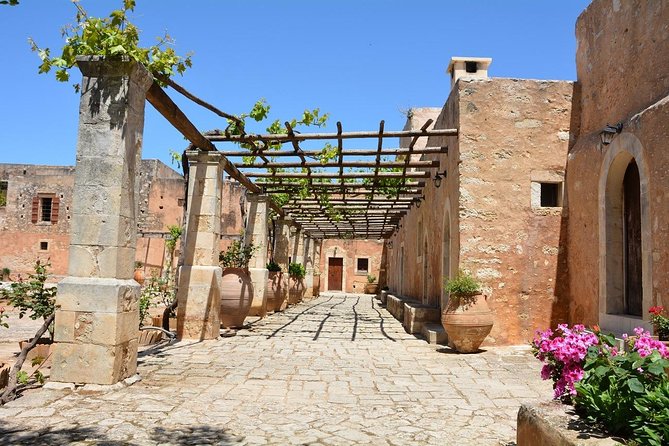
Arkadi is the most important historical stop on the route. Your guide explains its role during the Cretan revolution while you are still on the bus, then you have free time to walk through the monastery grounds.
The visit is built around the 1866 explosion, when people sheltering inside chose death rather than surrender. You can see the rooms connected with that event and follow the small stone paths through the complex. This makes the visit more than a quick church stop. The setting gives you a physical sense of how a religious center also became a place of resistance.
I like the free time here. A short guided explanation can give you the basic story, then you can move at your own speed and look at the rooms that interest you. If you want a detailed architectural tour, however, the one-hour stop may feel brief.
Arkadi also sets up the rest of the day. The tour is not presenting Crete as a collection of scenic stops. It is showing how religion, community, and resistance are tied together in local memory.
Admission is not included, so keep part of the €13 entrance budget available. Wear shoes that are comfortable on stone paths, and listen carefully to the bus explanation because it provides much of the historical context.
The archaeological site and museum at ancient Eleftherna cover a very broad span, from 3000 BC to AD 1300. That range lets you see Crete as a place of repeated settlement and change, not only as the home of the better-known Minoan sites.
The stop is scheduled for 40 minutes. That is enough for an introduction, but not enough for an unhurried museum visit and a close look at every display. If archaeology is your main reason for booking, this will probably be the stop you wish had more time.
One practical point matters here: the museum entrance is part of the extra €13 charge noted for the day. The short visit may also explain why one guest found the museum less satisfying than the monastery, cave, and pottery stops. That does not make Eleftherna unimportant, but it does mean you should set modest expectations.
I would treat this as a compact archaeological chapter between the more personal experience at Arkadi and the village visit at Margarites. You get a sense of the area’s long past, then return to living Cretan traditions.
Margarites is the most relaxed stop. The village is known for pottery, and you have two hours to walk through its traditional streets, browse the local craft shops, and stop for lunch at a small taverna if you wish.
The two-hour block is useful because it gives you room to choose. You can focus on pottery, sit down for a meal, or simply stroll without being rushed from one doorway to the next. Lunch is not included, so ask about the menu and prices before ordering if you are keeping the day inexpensive.
This is also the part of the tour where the difference between a living village and an archaeological site becomes clear. At Eleftherna, you look at evidence from earlier communities. In Margarites, pottery is still connected to daily life and local work.
Do not expect a large town or a full shopping district. The appeal is its traditional character and its connection with ceramics. If you want a souvenir that feels tied to Crete rather than a generic beach-market item, this is one of the better places on the route to look.
Near Margarites, the group visits Tsikalario Cretan Ceramics. Helen, the owner and artist, demonstrates how clay is shaped into an object that can be used.
That live process is the point of the stop. A pottery shop can feel like a sales visit, but watching the material change under the artist’s hands gives you a clearer idea of the skill involved. It also helps you understand why Margarites has such a strong pottery identity.
The visit lasts about 40 minutes and admission is included. You may have time to look around the workshop or consider buying a piece, but the information provided does not promise a particular shopping arrangement. I would enjoy the demonstration first and treat any purchase as optional.
This is one of the best stops for families and for anyone who prefers seeing a craft made rather than hearing a general explanation. It also breaks up the ancient and military history with something practical and human.
Melidoni Cave brings another story from the period of Ottoman occupation and the Cretan revolution. The cave is impressive in scale and atmosphere, but it is not only a natural attraction. Its historical importance is central to the visit.
You have about 40 minutes inside the cave area, and admission is extra. The stop is short, so this is a look rather than an extended geology visit.
There is an important drawback. Parts of the cave have been altered to make access easier and the interior more decorative. Some stalactites were cut away, which can be troubling if you expect an untouched natural site. I would not describe Melidoni as a pristine cave experience.
That criticism does not erase the historical value. The cave’s connection with the revolution gives the stop a serious purpose, and the rock formations still make it visually different from the monastery and museum. Just go knowing that access improvements have changed the natural interior.
The full outing lasts approximately eight to nine hours. The listed visits account for about five hours, with the remaining time used for driving, pickup, drop-off, and the meal break. Your exact rhythm will depend on where you are staying and how long the coach takes to collect the group.
Pickup is offered from Bali, Panormo, Skaleta, Adele, Platanias, Missiria, Rethymno town, Atsipopoulo, Kavros, and Georgioupoli. You wait outside your hotel reception ten minutes before the appointed time. Because pickups cover many resorts, the beginning and end of the day may involve several collection points.
English is offered. One booking experience involved English and French rather than German, so you should confirm the language arrangement if you need commentary in a language other than English. The supplied information does not name the main guide, but Helen is identified as the artist leading the ceramics demonstration.
Most people can take part, and the activity has a maximum of 50 participants. That makes the tour broadly accessible in terms of participation, but the group size can affect how close and personal the explanations feel.
Some versions of the day have also included an olive oil stop. If that is part of your departure, keep expectations practical: the tasting selection may be limited, and the stop is not the main reason to book this experience. The core route is Arkadi, Eleftherna, Margarites, Melidoni, and the pottery workshop.
I would recommend this day to you if you want a broad first look at Crete’s inland culture without hiring a car. It works well for people who like history but also want a village, a craft demonstration, and a natural attraction in the same outing.
It is a particularly good fit if you are staying in one of the listed resort areas. Pickup saves you the trouble of reaching a central departure point, and the air-conditioned vehicle makes the long route more comfortable.
Families may appreciate the changing subjects. A monastery can be followed by a museum, village food, pottery, and a cave, which is easier to manage than a full day of ruins. The cave and pottery workshop also give younger visitors something concrete to look at and do.
I would hesitate if you want a slow archaeological day. Eleftherna receives only 40 minutes, and a group of up to 50 people is not ideal for quiet museum study. I would also hesitate if cave conservation matters greatly to you, since Melidoni has been modified for access.
The tour received a 4.6 rating, with 100 percent recommendation shown in the supplied information. That fits the shape of the experience: its strongest points are the monastery, the cave’s historical connection, and the pottery visits. The museum and optional olive oil portion are less certain choices for every person.
You can cancel up to 24 hours before the local start time for a full refund. Changes or cancellations inside that window are not accepted for a refund, and the company may cancel if its minimum number is not reached. In that case, you are offered another date or experience, or a full refund.
The tour is often booked well ahead, with an average lead time of 51 days. That is useful to know if you are visiting in a busy season and need a particular pickup area or date.
Bring money for the €13 admissions and for lunch in Margarites. Since the route includes stone paths, a museum, a village walk, and a cave, sensible walking shoes are more useful than beach footwear.
I would also keep the day flexible. This is a long regional route, and the pickup network means your departure time may not match the first site visit exactly. Waiting outside reception ten minutes early is part of making the morning run smoothly.
Book it if you want one organized day that explains Crete through places and people, not just photographs. Arkadi gives the day its strongest historical meaning, Margarites and Helen’s workshop provide the most authentic craft connection, and Melidoni adds a memorable but imperfect cave visit.
Skip it if you want deep time at Eleftherna, a small private group, or an untouched cave. Also compare the full cost after adding €13 in admissions and lunch.
For most visitors staying along the north coast, this is a useful and fairly priced introduction to central Crete. Go for Arkadi, the pottery, and the chance to see more than the coast. Treat the museum as a short overview and Melidoni as a historical cave with visible changes made for access.
FAQ
A few more Heraklion half-days to weigh up
- From Heraklion: Historical Center City Tour & Knossos Palace
★ 4.4 · 340 reviews - Ecobike tour in historic Heraklion
★ 5.0 · 134 reviews - Knossos Palace & Historical Heraklion City Tour, with Old Market
★ 4.5 · 51 reviews
How long does Cretan Stories last?
The experience lasts approximately eight to nine hours, including transportation, pickup, drop-off, visits, and the time available for lunch.
Where does pickup take place?
Pickup and drop-off are offered in Bali, Panormo, Skaleta, Adele, Platanias, Missiria, Rethymno town, Atsipopoulo, Kavros, and Georgioupoli.
How early should I wait for pickup?
You should wait outside your hotel reception ten minutes before the appointed pickup time.
Same island, a completely different day out:
- Heraklion: Dia Island Sailboat Cruise with Swimming and Meal
★ 4.8 · 2,579 reviews - Heraklion Area: CRETAquarium Admission Ticket
★ 4.4 · 2,055 reviews - Crete: Palace of Knossos E-Ticket and Audio Guide
★ 3.8 · 1,540 reviews - Agia Pelagia Crete Quad Bike authentic backland Tour
★ 4.9 · 1,430 reviews
Are entrance fees included?
No. The stated extra cost for entry to Arkadi, the Eleftherna Museum, and Melidoni Cave is €13 per person.
Is the tour offered in English?
Yes. English is offered. The provided information also notes that some departures may use French, so confirm the language arrangement if that matters to you.
Can I cancel for a full refund?
Yes. You must cancel at least 24 hours before the experience start time for a full refund. Cancellations or changes made less than 24 hours before the start are not refunded or accepted.
Just added around Heraklion
- Crete: Knossos Palace & Heraklion City Tour★ 3.5 · 3 reviews
- Full-Day Tour:Lasithi Plateau -Mythology Park&Knossos Palace★ 3.0 · 3 reviews
- Knossos: Knossos Private Guided Tour★ 5.0 · 3 reviews
- Snorkeling Tour with Sea Scooter in Heraklion★ 5.0 · 3 reviews
- Heraklion: Holistic Massage: Revitalization of Body & Spirit★ 5.0 · 3 reviews
- Gramvousa and Balos Tour From Heraklion★ 4.0 · 3 reviews
- Heraklion: Walking city tour & Wine tasting★ 5.0 · 3 reviews
- Private Wine Tour at Peza Valley – 2 Wineries and Lunch at Peza★ 5.0 · 3 reviews
Historical Tours, compared.
Richtis Waterfall, History, Azoria, OliveTasting, NorthCoast
Read our review →
Heraklion Highlights: Knossos, Museum & Historic City Drive
Read our review →
Knossos Palace & Historical Heraklion City Tour, with Old Market
Read our review →
Chania Battle of Crete Private Tour: WW2 Military History
Read our review →
Small Group Eastern Crete Heritage Tour for Cruiseships
Read our review →Browse the lists this tour appears in